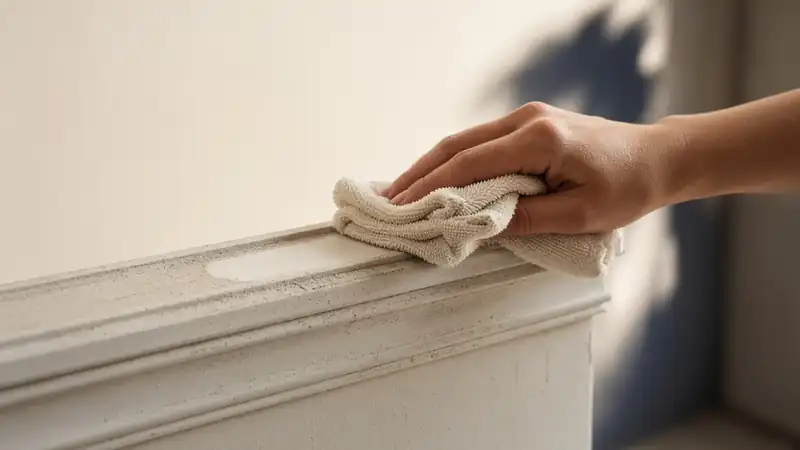
You spray the glass.
You wipe it.
You polish it.
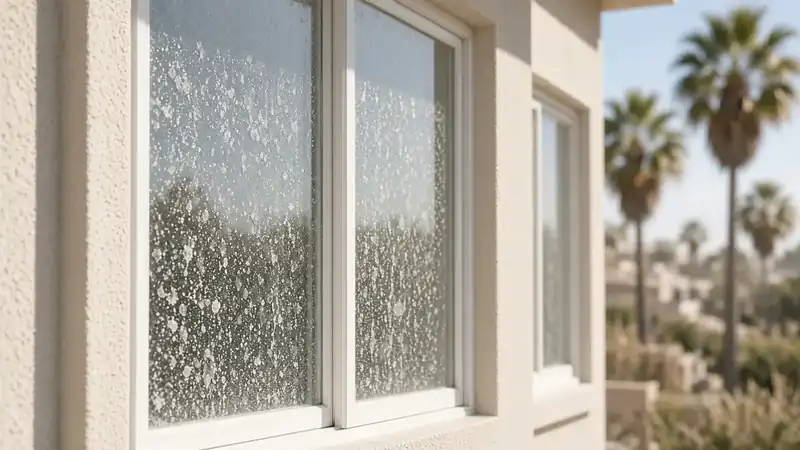
The window still looks cloudy.
At that point, many homeowners assume the problem is dirty glass or a bad glass cleaner.
Sometimes the problem is neither.
It is mineral buildup.
And Los Angeles has exactly the conditions that make hard-water spotting common.
Los Angeles Has Hard Water
The Los Angeles Department of Water and Power explains that water hardness varies across the city because Los Angeles receives water from multiple sources.
LADWP classifies water above seven grains per gallon as hard.
Its published figures show the San Fernando Valley and western Los Angeles averaging approximately 8.6 grains per gallon, while some other Los Angeles water-quality areas have historically recorded even higher averages.
Hard water is not the same thing as unsafe water.
It simply contains dissolved minerals, particularly calcium and magnesium compounds.
When a water droplet evaporates, the water disappears.
The minerals do not.
They remain on the glass.
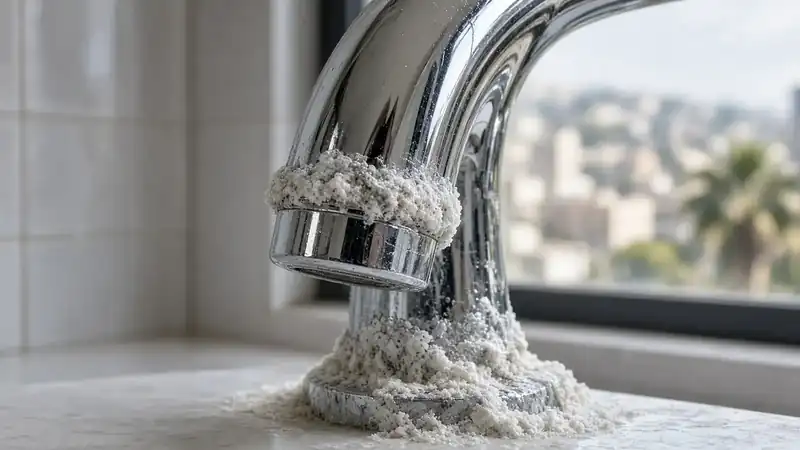
Repeat the process hundreds of times and a clear window can develop visible spotting or a hazy appearance.
Where Do the Spots Come From?
Common sources include:
- Sprinklers hitting exterior windows
- Hose water drying on glass
- Rain mixed with dirt and existing mineral residue
- Pool splash
- Irrigation overspray
- Shower glass
- Improperly dried window cleaning
A sprinkler aimed slightly too high can repeatedly coat the same window every morning.
The homeowner cleans the glass.
The sprinkler puts the minerals back.
The cycle continues.
Hard-Water Spots Are Not Ordinary Dirt
This is the most important distinction.
Ordinary dirt sits on the surface and can often be removed using standard window-cleaning methods.
Mineral deposits adhere more strongly.
As buildup becomes heavier, ordinary glass cleaner may remove fingerprints and dust while leaving the mineral pattern untouched.
That is why the window can be technically “clean” and still look terrible in direct sunlight.
Why Vinegar Sometimes Appears to Work
Mild acidic solutions can interact with certain mineral deposits.
That is why vinegar appears in countless household tips.
However, not every glass installation consists of bare glass.
Windows may contain:
- Special coatings
- Tint films
- Aftermarket treatments
- Painted frames
- Natural-stone surrounds
- Metal components
Using the wrong chemical can affect adjacent materials or specialty coatings.
Always follow manufacturer guidance.
For substantial buildup, professional evaluation is safer than progressively trying stronger DIY mixtures.
Why Scrapers Require Caution
A razor blade looks like an obvious solution for stubborn material.
But improper scraping can scratch glass or damage coatings.
Certain types of glass also require specific handling.
Professionals evaluate the surface before choosing an abrasive or scraping method.
The objective is not merely to remove the spot.
It is to remove it without creating permanent damage.
Why Microfiber Technique Matters
Some windows look cloudy because cleaner residue remains behind.
Too much product can make this worse.
Use clean tools.
Do not continue wiping glass with a saturated, dirty cloth.
Work systematically and finish the edges where liquid tends to collect.
Direct sunlight can also cause cleaning solution to dry too quickly, leaving streaks before you can remove it.
Do Not Ignore Window Tracks
The glass gets all the attention.
The track may contain years of dust, insects and debris.
A fully detailed window area usually includes more than the pane itself.
Depending on the service scope, it may involve:
- Glass
- Frames
- Sills
- Tracks
- Screens
- Interior surfaces
- Exterior surfaces
Because these elements require different methods, confirm exactly what a window-cleaning quote includes. We clean residential and commercial glass across greater Los Angeles — pane, frame, sill, and track when the scope calls for it.
Can Hard-Water Stains Become Permanent?
Mineral buildup should not be ignored indefinitely.
Long-term deposits can become progressively harder to remove and, in some circumstances, glass can develop surface damage or etching that cleaning alone cannot reverse.
That is why prevention is significantly easier than restoration.
How to Prevent Hard-Water Stains
Redirect Sprinklers
This may be the single most effective step.
Water used for landscaping should not repeatedly strike windows.
Adjust sprinkler heads and replace malfunctioning nozzles.
Dry Windows After Hose Exposure
Do not leave hard water to evaporate if it can reasonably be removed.
Maintain Glass Regularly
Light deposits are generally easier to address than years of accumulation.
Inspect Irrigation
Many homeowners focus on the glass while ignoring the machine depositing minerals onto it every morning.
Fix the source.
Pay Attention to Shower Glass
The same principle applies indoors.
Use a squeegee after showering where practical.
Reducing the amount of water allowed to evaporate on glass reduces deposits.
Why Professional Window Cleaning Can Look So Different
Professional window cleaning is not simply a person holding a spray bottle.
Tools, solution ratios, edge work, glass assessment and drying technique all influence the final appearance.
Hard-water restoration adds another layer because the technician must determine:
Is this ordinary soil?
Light mineral buildup?
Heavy mineral buildup?
Surface damage?
A coating?
Something on the inside of insulated glass that cannot be accessed?
Correct diagnosis prevents wasted effort.
What If the Cloudiness Is Between the Panes?
Cleaning cannot reach the sealed space between panes of insulated glass.
If fogging appears to exist inside a double-pane window rather than on an accessible surface, the problem may involve the window unit rather than ordinary cleaning.
No amount of exterior polishing will remove something trapped inside the sealed assembly.
That is another reason professional inspection can be useful.
Residential Versus Commercial Window Cleaning
Commercial glass has different challenges.
Storefront windows accumulate fingerprints, traffic film, sprinkler spots and street dust.
Appearance matters because the glass is part of the customer experience.
A cloudy residential window reduces the view.
A cloudy storefront can make the entire business look poorly maintained.
Regular service can prevent mineral and dirt accumulation from reaching the point where restoration becomes necessary.
How Often Should Windows Be Cleaned?
There is no single correct schedule.
Consider:
- Exposure to sprinklers
- Traffic
- Ocean air
- Pets touching glass
- Children
- Construction nearby
- Window orientation
- Landscaping
- Business foot traffic
- Some windows remain presentable for months
- Others require frequent attention
- Use condition rather than an arbitrary calendar
The Los Angeles Advantage—and Problem
One of the best parts of living in Southern California is the amount of sunlight.
That sunlight also exposes every flaw on glass.
Streaks invisible in the morning can become obvious by afternoon.
Hard-water spots can turn a beautiful view into a hazy one.
Fortunately, understanding the cause makes the solution much simpler.
If the glass looks dirty immediately after ordinary cleaning, do not keep adding more glass cleaner.
Determine whether you are looking at mineral deposits.
Then remove the source creating them.
For Los Angeles homeowners and businesses who need the glass actually clear, Extreme Quality Clean handles window cleaning alongside residential, commercial, carpet and floor work. Request a quote or call (818) 294-3141. You get the number before we start.
Clear windows begin with clean glass.
But keeping them clear begins with controlling the water that reaches them.